
Information for Parents
Here at St Clare’s we always admire the efforts of parents to create the best life for their child. Parents are the child’s primary educators, and a child’s experiences at home is one of the most potent factors on their development during the primary school years. There is a continuing process through which the child’s formal learning experience in school interacts with the less formal developmental experience of the home and the family.
It is widely recognised that significant educational, social and behavioural benefits occur as a result of effective partnership between parents and teachers. Close co-operation between the home and the school is essential, therefore, if children are to receive the maximum benefit from the curriculum.
Each child will have a student support plan in place to address the specific needs of the student both in school and at home. However, if you would like to explore other resources which can use at home please see our Resources page where we have compiled some useful links and information for parents.

We’re delighted to announce that registration is now open for NPC’s Tomorrow’s World – Education Conference 2026, taking place on Saturday, 7 November 2026, at Kildare Town Community School.
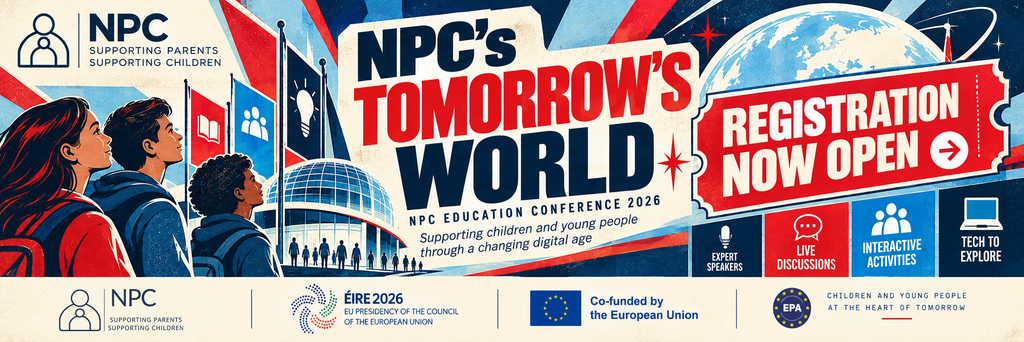
Technology is transforming the world around us, influencing how children and young people learn, communicate, develop relationships and experience education.
From artificial intelligence and emerging digital technologies to new approaches to learning, the opportunities are enormous. But these developments also raise important questions about safety, inclusion, wellbeing and the future of education.
How can we ensure that technology works for every child, and that parents have a meaningful voice in shaping what comes next?
That’s exactly what we’ll be exploring at Tomorrow’s World.
Bringing together parents, educators, education leaders, policymakers and experts, the conference will provide an opportunity to explore the possibilities, consider the challenges and discuss how we can work together to support children and young people in an increasingly digital world.
We invite parents, Parents’ Associations, educators and everyone with an interest in the future of education to join us. Click here to register.
School Uniform
Dear Parent’s,
St Clare’s uniform is now available from:
D. Neylon Menswear
Neylons Boutique
No.17 Lower Market Street,
Ennis,
Co. Clare
V95Y2W6
The white polo top element of the uniform can be purchased from Neylons Menswear shop or from Dunnes Stores or Pennys.

Parents’ Association
Our Parents’ Association plays an active role in school life, supporting events, fundraising, and building community. Learn how you can get involved.
Useful Resources
Quick links to resources such as lunch menus, after-school clubs, or online learning tools.
Admissions
Details of our enrolment procedures, criteria, and application process.

Bí Cínealta
Policies outlining our proactive approach to preventing and addressing bullying, and ensuring respect and inclusion for all.
Curriculum Polices
Our Curriculum Policies outline the school’s approach to teaching and learning across all areas of the curriculum. They provide clear guidance on planning, delivery, assessment and progression, ensuring that learning is meaningful, inclusive and appropriate to pupils’ individual needs.
Health and Safety
Our Health and Safety framework sets out how our organisation aims to prevent incidents and injuries. It is a set of principles, rules and guidelines that informs how we will ensure ongoing compliance with Health and Safety standards.
Medical Policies
This policy sets out how we at St Clare's School deliver medical supports, and the roles and responsibilities of all parties in working together.
Postitive Behaviour
These policies outline the aims and objectives, and standards for promoting positive behaviour in our school.
Safeguarding
Child Protection and safeguarding policies, including our Designated Liaison Person (DLP) and responsibilities under national guidelines.